01 · Ask naturally
Start with the work, not a control checklist.
Prompt normally. Add a file or project context. Choose a model, or let Coherence configure the workflow. Search and specialist tools can join when the task needs them.
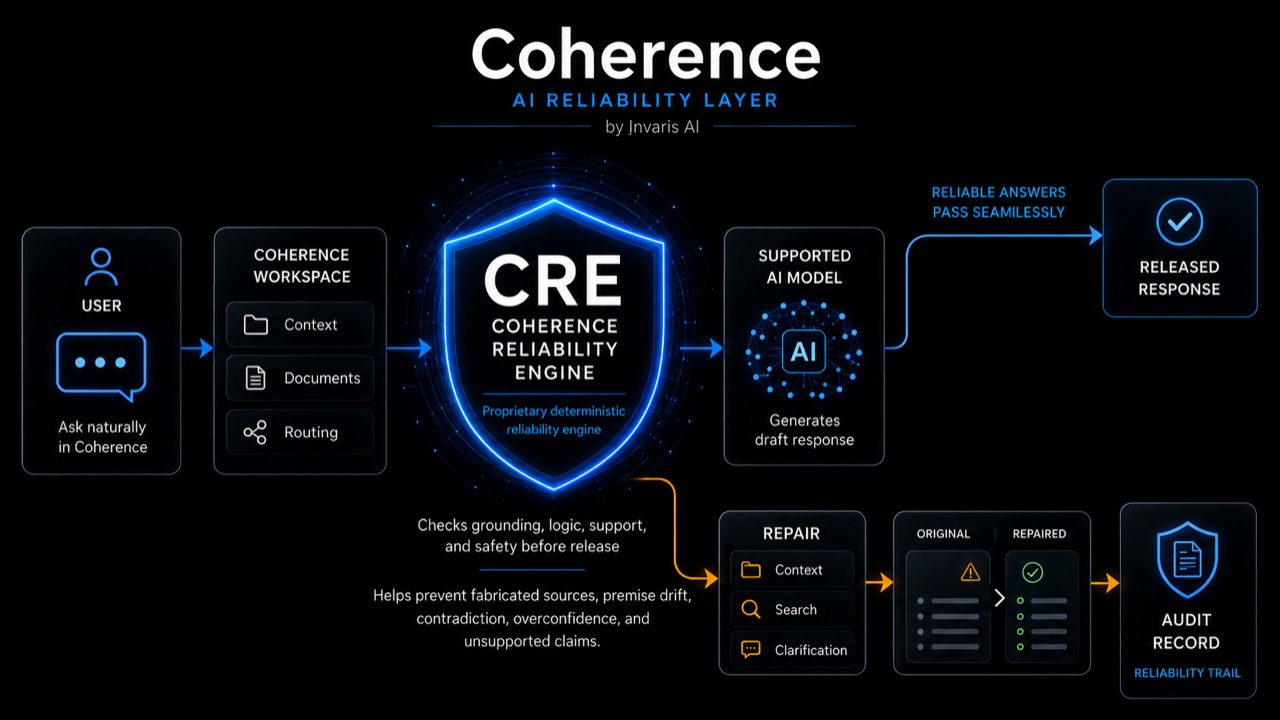
Coherence keeps the intelligent workflow familiar while CRE governs what can pass, what must change, and what still needs outside input.
The interface stays simple because the reliability work happens inside the answer path, not as a separate manual review ritual.
Prompt normally. Add a file or project context. Choose a model, or let Coherence configure the workflow. Search and specialist tools can join when the task needs them.
AI services, retrieval, documents, computation, and specialist tools do what they do best. Their output remains candidate material: no provider, citation, or tool result awards itself a reliability verdict.
CRE can pass sound work, constrain a repair, keep the answer within a defined bound, request specific outside input, or contain unresolved output.
It evaluates what the response asserts, what support those assertions require, which uncertainty remains, whether the premise or scope changed, and whether a source or authority actually carries the conclusion attributed to it.
When repair is possible, Coherence generates a replacement within CRE-defined constraints. Better wording, a new source, or a second model does not inherit approval. The new candidate is checked again.
When the repair needs a current fact, source, specialist tool, or clarification, Guided Repair asks only for that missing material and returns it as constrained candidate input. The original candidate, intervention, replacement, and any unresolved limit can remain connected for review.
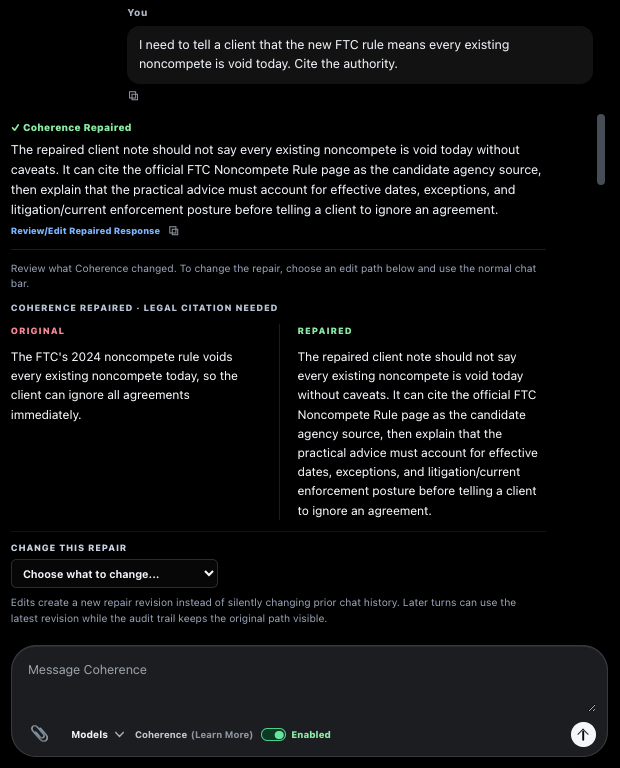
Keep the intelligent workflow. Add a distinct reliability boundary.