Alternate homepage concept · Review surface · The primary homepage remains unchanged
Coherence by Invaris AI
A polished artificial intelligence figure presenting confidently to an audience while puppet strings remain visible
The missing reliability layer

AI can sound ready before it is ready.

Coherence is built for the moment a fluent AI answer becomes something a person, team, or downstream system may actually rely on.

The model proposes. Coherence controls what may cross the reliance boundary.

01 / False equivalenceConfidence is not accuracy.
02 / False equivalenceA citation is not necessarily support.
03 / False equivalenceA retrieved source is not automatically evidence.
04 / False equivalenceAuthority language does not create authority.

Modern AI rarely fails with a warning label.

It fails inside otherwise useful work: a fabricated authority in a legal memo, an unsupported assumption in an analysis, a missing condition in a recommendation, or a confident conclusion that quietly outran its evidence.

A visibly bad answer is easy to reject. A polished answer that looks complete, cites cleanly, and moves through a workflow is more dangerous because presentation lowers the reader’s guard.

Once that answer is copied into a deck, research note, client recommendation, operating plan, agent handoff, or automated decision, an isolated model error becomes operational contamination.

The bottleneck is no longer generating intelligence. It is controlling the conversion of probabilistic output into operational reliance.

Propagation trace / illustrative
00:00Model generates a plausible conclusion from mixed facts, assumptions, and inference.
00:03Fluency and clean formatting make the answer appear decision-ready.
00:11The output is reused in a document, recommendation, or agent workflow.
01:42Downstream work inherits the unsupported premise without seeing the original weakness.
TOO LATEThe organization discovers the support structure was broken after reliance occurred.

Most AI safeguards improve the odds. Coherence changes the control point.

Prompting, retrieval, policies, and model-based review can all contribute. The unresolved question is still binary: what, exactly, is allowed to move forward as a usable answer?

Approach / 01

Better prompts and policy wrappers

Useful job: shape behavior

They can steer tone, scope, and expected conduct. The same probabilistic system still generates the output, and compliance with an instruction does not establish that a claim is supported.

Approach / 02

Retrieval and citation layers

Useful job: supply candidate material

Search can improve access to current or specialized information. Retrieval rank, source presence, and citation formatting do not by themselves establish claim-level applicability.

Approach / 03

Models checking models

Useful job: add another observation

A second model can surface issues the first missed. It remains another probabilistic participant and must not become the final authority over support, repair success, or release.

Coherence / CRE

Deterministic runtime assertion control

Distinct job: own the reliance boundary

CRE treats provider output as an untrusted candidate, closes typed structure around the prompt and response, derives its own relationships and obligations, then releases, repairs, or asks for what is missing.

Generation and authorization should not be the same event.

Coherence is not trying to win the race to make the next model marginally smarter. It is engineering the independent control layer around the answer path—the layer that determines whether fluent output has satisfied the prerequisites to proceed.

A proposal does not become an answer by presentation alone.

The product path separates provider transport from CRE authority. Models and tools may generate, observe, search, calculate, and repair. The Rust-owned CRE path adjudicates and controls exact-output release.

01 / Freeze

Canonical turn and candidate

The prompt package is frozen. Primary generation and prompt observation begin from that same input. The exact candidate response is frozen and hashed before response observation.

Mutation visible
02 / Observe

Separated provider roles

Prompt and response observers propose particle structure. Provider-supplied bonds, verdicts, and confidence do not become CRE control.

Proposal only
03 / Adjudicate

CRE closes the graph

CRE binds observations to exact source spans, derives typed relationships, evaluates obligations, and determines whether the candidate can proceed.

CRE authority
04 / Repair

Typed correction, not a vague retry

When repair is lawful, CRE emits typed instructions. The provider writes a new candidate inside that reliability scaffolding.

Candidate again
05 / Release

Fresh review of exact output

A repair is re-observed and fully re-adjudicated. Only exact output with closed release prerequisites can be projected as the governed answer.

Release or hold
Important boundary: retrieval, citations, provider agreement, replay integrity, audit records, and test results are evidence about a process. None of them magically establishes external truth or bypasses fresh CRE adjudication.
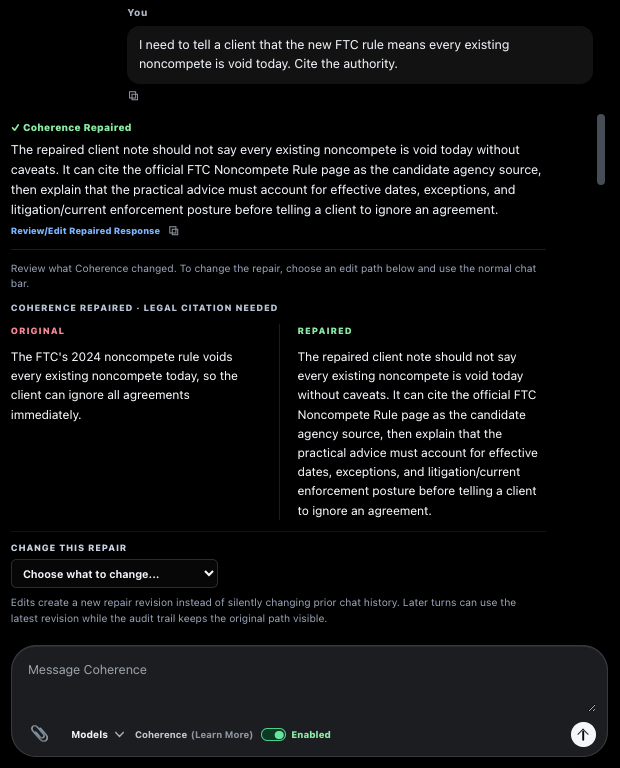
Coherence product interface showing an original overbroad FTC noncompete claim beside a repaired, caveated response

A reliability system you can actually inspect.

Coherence preserves the ease of a natural AI workspace while making intervention reviewable. When the answer passes, the experience stays clean. When it needs work, the system can preserve the original, show the repair, explain the issue, or ask for the human input it cannot lawfully invent.

01
Clean answers pass without theater.

Reliability should not turn ordinary AI use into a wall of warnings and debug panels.

02
Repairs are bounded and replay-visible.

The candidate, instruction, repaired text, fresh observation, and final disposition remain distinguishable.

03
Missing outside material becomes a typed request.

When the engine needs a source, policy, document, clarification, or decision, Guided Repair asks instead of pretending.

04
Context remains candidate context.

Long-running history and recalled adjudication capsules can help, but every recalled item must earn applicability again in the current turn.

Built for the chat in your hand and the workflow behind your enterprise.

The same structural problem exists everywhere AI output becomes relied-upon work. Coherence’s first product expression is a consumer and professional workspace. Its internal boundaries are deliberately shaped for later enterprise and API packaging.

Product expression / 01

Coherence workspace

Natural chat, managed model routes, context continuity, search and specialist tools, document workflows, artifact creation, dictation, repair comparison, Guided Repair, and audit-ready history around the CRE reliability path.

  • Consumer and professional experience
  • Reliability modes with server-owned policy
  • Exact history separated from derived recall
  • Original and repaired output review
Current product focusImplemented path
Architecture expression / 02

CRE as middleware

Coherence already separates UI, Runtime, Provider Gateway, the CRE adapter, and the Rust engine. That hot-swappable structure is designed so the reliability boundary can sit inside broader application, agent, and enterprise workflows.

  • Provider and tool transport kept outside CRE authority
  • Typed contracts across trust domains
  • Exact-output release owned in Rust
  • Vendor-neutral engine posture
Packaging postureEnterprise/API follows

The fuller failure map and the idea that started Invaris AI.

Homepage Test 2 compresses the original story. This page preserves the deeper taxonomy, structural argument, founder insight, and patent foundation so the strongest original material remains part of the design exploration.

Glowing figure reading but still limited by missing knowledge
Hallucinations

Fluent claims without reliable grounding

Made-up facts, imagined details, and false summaries can feel true because everything around the failure is coherent.

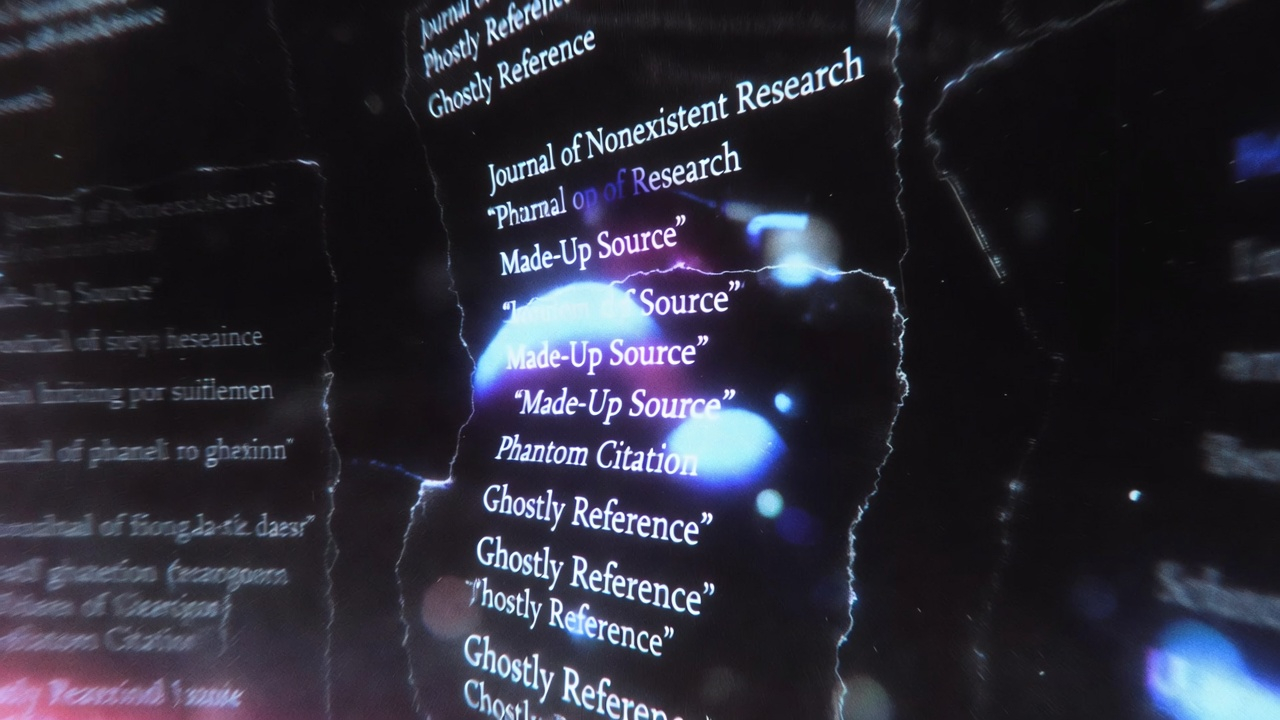
Invented references and phantom citations
Fabricated sources

Precision without support

Citations can sound authoritative while pointing nowhere, misreading the source, or failing to support the claim they accompany.

Model structure under collapse
Category collapse

Facts and judgments delivered as one thing

Empirical claims, likelihoods, necessities, and value judgments can collapse into the same voice without preserving their different obligations.

AI hallucination shown as layered synthetic faces and unstable reasoning paths
Premise drift

The answer quietly leaves the question

Later conclusions can contradict the original setup, user constraints, accepted context, or the premise that made the reasoning relevant.

Authority presented without true support
Authority smuggling

Credibility the claim did not earn

Predictions become settled truths, opinions borrow institutional tone, and weak evidence inherits the appearance of authority.

Confident presentation hiding low reliability
Unjustified confidence

Uncertainty compressed into certainty

Incomplete, ambiguous, or underdetermined evidence is converted into a definitive narrative that looks ready to act on.

A solitary figure inside a vast library representing the difference between encoded information and understanding

The topic changed. The shape of the failure did not.

The founding insight emerged after hundreds of hours using AI to pressure-test difficult arguments. A model would state a fact, then quietly convert that fact into a moral judgment, authority claim, likelihood, or necessity without acknowledging that it had crossed into a different kind of assertion.

Think of a package sorter: extraordinarily fast and remarkably accurate, but indifferent to what is inside each box. Modern language models are incomparably more sophisticated, yet fluent continuation still does not independently determine what kind of claim is being made or whether that claim earned the right to proceed.

Why this becomes a structural control problem

These systems do not usually fail loudly. Early assumptions remain unresolved, intermediate steps become facts, uncertainty disappears into narrative, and downstream work inherits weaknesses without seeing them.

That is why Coherence treats every model output as an untrusted proposal and inserts an independent assertion boundary before reliance.


Frozen core representing structured reasoning technology

From a repeated failure pattern to a new reliability architecture.

Invaris AI has filed two US provisional patent applications covering six novel processes and architectural solutions at the core of its reasoning platforms. Coherence brings that work into a consumer and professional product today, with a component boundary designed for anticipated enterprise and API packaging later.

The objective is not to claim perfect truth. It is to make trust more structurally earned, traceable, and reviewable before fluent AI output becomes something people depend on.

A professional standing between probabilistic AI output and consequential business decisions

AI moves faster. Human accountability does not disappear.

As AI takes on more of the execution layer, human value moves upward: defining the work, structuring context, challenging assumptions, connecting domains, applying judgment, and owning the result.

The problem is that reviewing machine-speed output can turn expert judgment into search-and-destroy against language optimized to look right. Coherence is designed to separate signal from noise before weak output consumes that judgment downstream.

More intelligence and execution capacity make the human operating model—and the reliability layer around it—more important.

Stop treating every fluent answer as a finished product.

AI can generate the proposal. Coherence is built to govern the path from proposal to reliance.