
Hallucinations
Fluency fills the gap.
Made-up facts, false summaries, or imagined details can feel true because the language around them is coherent.


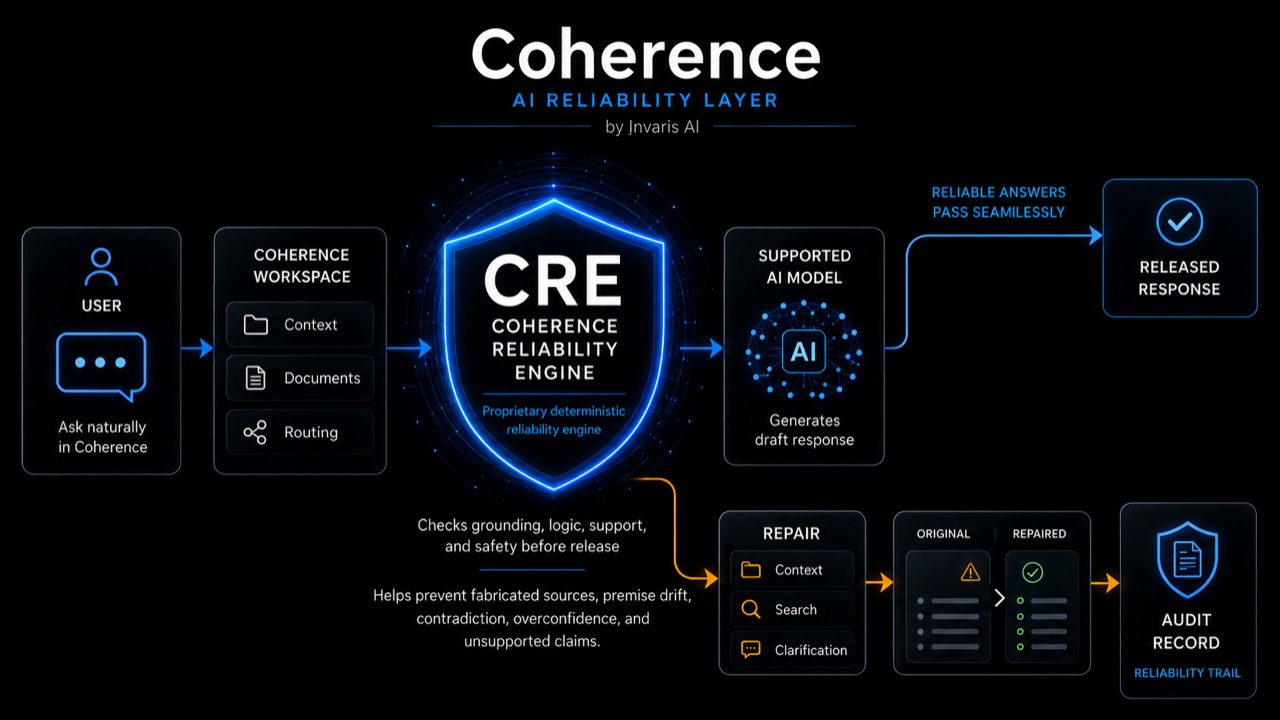
The model proposes. Coherence controls what may cross the reliance boundary.
AI can hallucinate, overstate confidence, invent sources, drift from the premise, and still sound ready to use. Coherence is built for that gap: not as a clever prompt, a models-checking-models loop, or retrieval dressed up as certainty, but as a deterministic reliability layer around the answer path.
CRE treats fluent output as a proposal. It evaluates the structure, repairs weak output when possible, asks for outside material when necessary, and preserves what changed before the response becomes something you use.
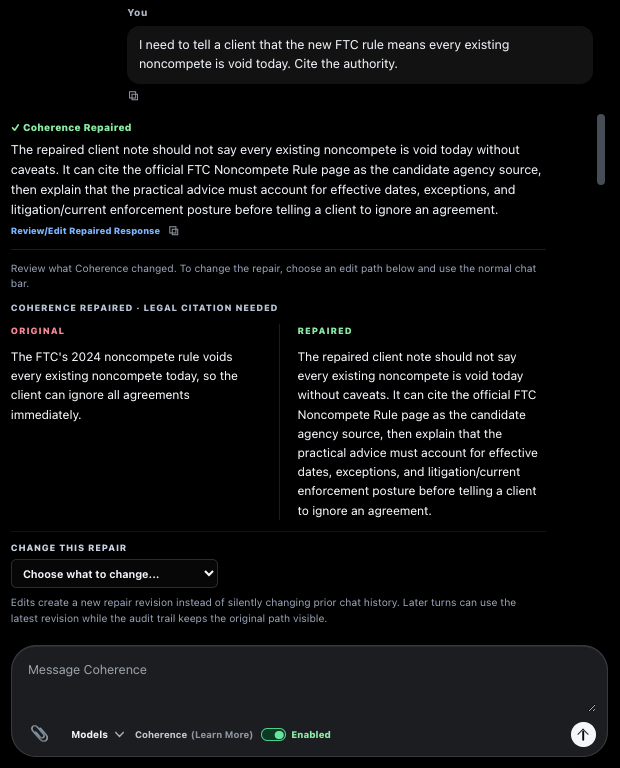
Coherence separates the useful work models and tools can do from the authority to release a governed answer. Open each stage to see how the path changes.
AI does not retrieve truth on demand. It estimates what to say next from the words, context, sources, and patterns in front of it. That guessing can be extraordinarily useful, but it becomes fragile under ambiguity, missing evidence, unstable authority, or unfamiliar situations.
The answer is not less AI. It is a different layer around AI—one designed to govern the conversion of fluent generation into operational reliance.
The original homepage’s full failure gallery is compressed here into a scrollable field guide. The broader taxonomy and structural story continue on Homepage Test 1.
Made-up facts, false summaries, or imagined details can feel true because the language around them is coherent.
A clean citation can sound authoritative while pointing nowhere, misrepresenting a source, or failing to support the actual claim.
Facts, likelihoods, value judgments, and necessities can be delivered in the same confident voice without preserving their distinct obligations.

Predictions become settled conclusions, opinions borrow institutional tone, and weak support inherits the appearance of authority.

Incomplete or underdetermined evidence is compressed into a single definitive narrative that looks ready to act on.
Coherence is a reliability-first AI workspace for founders, analysts, operators, attorneys, researchers, students, consultants, and anyone whose work depends on AI output being more than fluent.
It keeps the natural chat experience people already understand, then places CRE—the provisionally patented Coherence Reality Engine—behind the answer path. Prompt rules, retrieval, and model judges can help. CRE owns a different job: the assertion boundary where generated language may become something a person or workflow acts on.

Most AI tools give you a fluent answer and leave the reliability problem to you. Coherence keeps the familiar workspace, but inserts a system designed to notice when an answer has outrun what it can support.
CRE looks for weak support, missing context, broken relationships, contradiction, premise drift, and authority the candidate has not earned.
When repair is lawful, Coherence sends typed instructions to the provider and treats the resulting text as a new candidate requiring fresh review.
If the system needs a source, policy, document, clarification, or human judgment, Guided Repair asks instead of laundering uncertainty into confidence.
The browser can project governed answer text only from the Rust-owned exact-output release boundary after its prerequisites close.
AI fluency does not equal logical coherence.
A response can sound polished and still be flawed, unsupported, fabricated, or structurally unfit for the question that produced it.
The point is not to make AI sound more careful. The point is to improve the answer path before a person, team, or downstream workflow relies on it.


Invaris AI has filed two US provisional patent applications covering six novel processes and architectural solutions at the core of its reasoning platforms. Coherence brings that work into a product built for AI in your pocket, in your workflow, and increasingly in front of consequential decisions.