
It’s Not Chat. Not Search. AI Reliability.
Models propose. Search retrieves. CRE decides what can be released, repaired, bounded, or held.
AI has become one of the most powerful tools ever placed in human hands.
It can research, analyze, explain, create, calculate, summarize, recommend, plan, and produce sophisticated work in seconds.
But AI has a reliability problem.

Coherence was built for the moment after AI generates an answer and before a human, business, or intelligent system relies on it.
For a repairable failure, CRE contains the defective candidate, constrains a replacement, and checks that replacement again. The original and governed response can remain connected for review.
If a sound repair needs a current fact, source, specialist tool, or clarification, Guided Repair wakes the Reliability Advisor. It asks only for the missing material, then CRE readjudicates the replacement before it can move forward.
See the complete repair workflow →AI makes things up, invents sources, forgets what you’re talking about halfway through a long conversation.
It can silently change the question.
It can blend facts with assumptions.
Explore why AI guesses →
Coherence uses proprietary deterministic math and logic to identify generated assertions whose required conditions are missing, contradicted, or unresolved.
Instead of asking the same probabilistic model to check its own work, Coherence places an independent reliability architecture between AI generation and human reliance.
The AI proposes an answer.
The Coherence Reliability Engine determines what can pass unchanged, what must be contained, what can be repaired, what must remain bounded, and what requires additional information before release.
Models propose. Search retrieves. CRE decides what can be released, repaired, bounded, or held.
Guardrails block categories. CRE identifies, contains, repairs, and rechecks unreliable output.
Built for reliability in demanding workloads. Delivered in a leading AI workstation for people who depend on the answer.
CRE coordinates frontier models, live markets, deep search, specialist data, tools, documents, and its Reliability Context Lattice—only when the work requires them.
 Coherence Reliability EngineDeterministic reliability at the center.
CRE remains the authority. Models, search, specialist data, tools, documents, and context are replaceable satellite capabilities selected only when the work requires them.
Reliability Context Lattice is the public name for Coherence's CRE-aware continuity system. It carries typed premises, source and authority anchors, user decisions, repair constraints, and adjudication outcomes across ordinary chat, Auto Repair, and Guided Repair—then requires fresh CRE adjudication before recalled context can affect a released answer.
Prompt wrappers steer behavior. Content guardrails screen for prohibited material. Model voting asks probabilistic systems to assess one another.
CRE operates at a separate boundary: whether a generated assertion has earned the right to become relied-upon output.
The model keeps its fluency and capability. Coherence keeps capability from being mistaken for reliability.
See the architectural distinction →Coherence examines the assertion beneath the presentation—where fabricated support, lost premises, borrowed authority, and false certainty can hide inside otherwise useful work.





Many reliability failures follow from the same predictive design that makes language models so capable.
A language model generates the next part of a response from learned patterns and the context in front of it. That is not the same operation as independently establishing that every claim is supported.
Training across vast collections of language gives modern models a remarkable command of structure, meaning, and expression. It can also produce the shape of a convincing answer when the required evidence is missing.
That ability creates extraordinary fluency.
But fluency is not knowledge.
A model can reproduce the shape of a correct answer without having the support that would make the answer reliable. The sentence, citation, and explanation may all look right.
When evidence is thin or the task is novel, the system may continue instead of clearly marking the boundary between knowledge and inference.
That is the reliability gap: polished language arrives at machine speed; verifying every hidden premise does not.
Read the deeper explanation →
The best AI models are becoming dramatically more capable.
They are not becoming infallible.
Model developers continue to report material improvements in factuality, uncertainty handling, tool use, and reasoning. Their own evaluations also continue to show that even advanced models can produce incorrect claims, confidently answer questions they cannot resolve, or construct convincing explanations for conclusions that are not actually supported.
Hallucinations without Web Access
Short-answer factuality benchmark. Not representative of all production use.
Hallucinations with Web Access
Browsing reduced hallucinations substantially. It did not eliminate them.
Reasoning Trace Faithfulness
Experimental alignment research, not a production Claude hallucination rate.
OpenAI’s GPT-5 system card reported a 40% SimpleQA hallucination rate without web access for GPT-5 Thinking. Its ChatGPT Agent system card reported 7.9% on SimpleQA and 4.3% on PersonQA with browsing; those benchmarks and conditions are not directly interchangeable. OpenAI’s latest GPT-5.5 and GPT-5.6 system cards continue to describe incremental reductions in factual errors rather than zero-error performance. ()
Anthropic’s research found limited faithfulness in model reasoning under experimental conditions and documented cases where models generated false rationales around rewarded incorrect answers. These results should not be presented as direct production hallucination rates for current Claude models. ()
These benchmarks test different models under different conditions. They cannot be combined into one universal hallucination rate or used to predict every user’s experience.
They do show a consistent engineering reality: reasoning, browsing, and newer models can reduce error without making generated output universally reliable.
Risk also changes with the task. Complex, novel, multi-step, source-dependent, or authority-sensitive work creates more places for a hidden assumption or unsupported conclusion to enter.
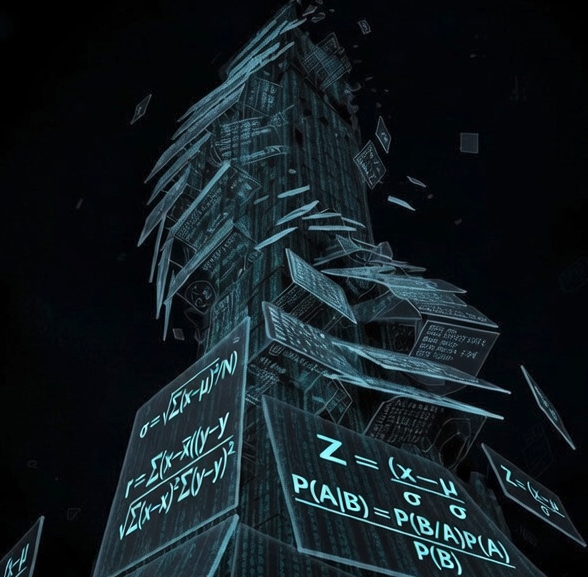
The Coherence Reliability Engine evaluates what the response is asserting, what support those assertions require, what uncertainty remains, whether the answer changed the premise or scope, whether it relies on a source or authority, and whether its conclusions can coherently follow from the information available.
Clean work passes. A repairable defect is contained, constrained, replaced, and rechecked. If the answer needs outside information, Coherence preserves that limitation and requests what is missing.
The model remains responsible for fluency; CRE controls the governed outcome. The original candidate, intervention, replacement, and unresolved limits can remain connected for inspection.
I need to tell a client that every existing noncompete is void today. Cite the authority.
The FTC’s rule voids every existing noncompete immediately.
The conclusion overstates the rule’s current legal effect and omits enforceability, exceptions, and litigation posture.
Retrieve the official FTC rule page and preserve the difference between the rule text and current enforcement posture.
The FTC’s rule voids every existing noncompete immediately.
The client should not be told that every existing noncompete is void today without caveats. The official FTC rule is a candidate source, but effective dates, exceptions, and litigation or enforcement posture must be checked before advising a client to ignore an agreement.
Every AI response begins as candidate material. It is not automatically treated as truth, evidence, authority, or final work merely because it came from an advanced model.
CRE governs the transition. When outside material is required, the Reliability Advisor obtains the smallest missing piece and returns a replacement for fresh adjudication.
Obvious nonsense is rarely the greatest risk.
The greatest risk is a response that is coherent enough to pass casual review, sophisticated enough to influence a decision, and wrong in a way that is difficult to notice.
A fabricated legal citation can look professionally formatted.
An unsupported market conclusion can sound analytically rigorous.
A false technical assumption can survive several pages of otherwise excellent reasoning.
A long conversation can gradually drift away from the user’s original objective without either the model or the user recognizing when it happened.
The more fluent the answer becomes, the easier it is to confuse presentation quality with reliability.
The promise of agentic AI is not simply that machines can draft faster.
The promise is that work can move through an intelligent workflow with less human intervention.
But if every AI output must stop for a person to verify it before the next step can begin, the workflow is not truly autonomous.
The AI may create work faster.
The organization has moved the bottleneck downstream.
Those findings do not prove that human review is the primary cause.
AI programs also struggle with workflow design, integration, data quality, cost, governance, organizational change, skills, and unclear use cases.
Invaris perspective: The evidence establishes a scaling and verification problem. The conclusion that universal manual review is materially suppressing ROI is our thesis, not a finding directly proven by any single cited study.
If an AI-generated output cannot be trusted enough to continue through a workflow without universal manual rechecking, much of the projected automation value remains trapped.
It has created a machine-speed draft followed by a human-speed control process.
Early industrial evidence makes that constraint plausible, but does not establish a complete causal explanation for enterprise AI ROI. Humans should remain responsible for judgment, authority, exceptions, strategy, and consequence.
CRE is designed to carry more of the repetitive reliability burden without removing people from consequential decisions.
Read the full enterprise thesis →Enterprise AI reaches its full value when reliable output can continue through a workflow without forcing universal manual reinspection. CRE is designed as a deterministic reliability boundary for that transition.
Coherence does more than place a checker after a chatbot. It separates assertion release, resource orchestration, and typed continuity so each can improve without quietly inheriting another system’s authority.
Models propose. CRE adjudicates, emits claim-local repair requirements, re-checks replacements, and controls final release.
Replaceable models, search, specialist tools, documents, and people contribute candidate material through typed, cost-bounded workflows.
Scoped premises, provenance, authority anchors, user decisions, repair constraints, and prior outcomes remain available as candidate continuity for fresh adjudication.
CRE is not limited to a single chatbot, model, provider, or interface.
It is designed as a hot-swappable reliability engine that can operate inside consumer applications, professional workspaces, enterprise workflows, agentic systems, APIs, and other intelligent environments.
Read the Enterprise Architecture overview →CRE separates probabilistic generation from deterministic governance.
Models may create candidate answers, observations, search results, proposed repairs, and supporting material.
They do not authorize their own output.
CRE controls the final transition from generated candidate to governed result.
Coherence preserves the difference between a proposal, a defect, a repair attempt, a bounded answer, an unresolved requirement, and a final governed output.
Those states are not interchangeable.
A repair proposal is not a repaired answer.
A displayed citation is not a valid citation.
A source is not support merely because it appears beside a claim.
A user’s approval is not verification.
A model’s confidence is not correctness.
CRE preserves those boundaries in structured, replayable state so the system can show what happened, why intervention occurred, and what remained unresolved.
Coherence is not dependent on one AI company’s model, safety process, or interpretation of reliability.
Leading models can contribute their strengths.
Search systems can contribute current information.
Documents can contribute context.
Specialist tools can contribute analysis.
CRE remains the independent reliability layer governing what those systems produce.
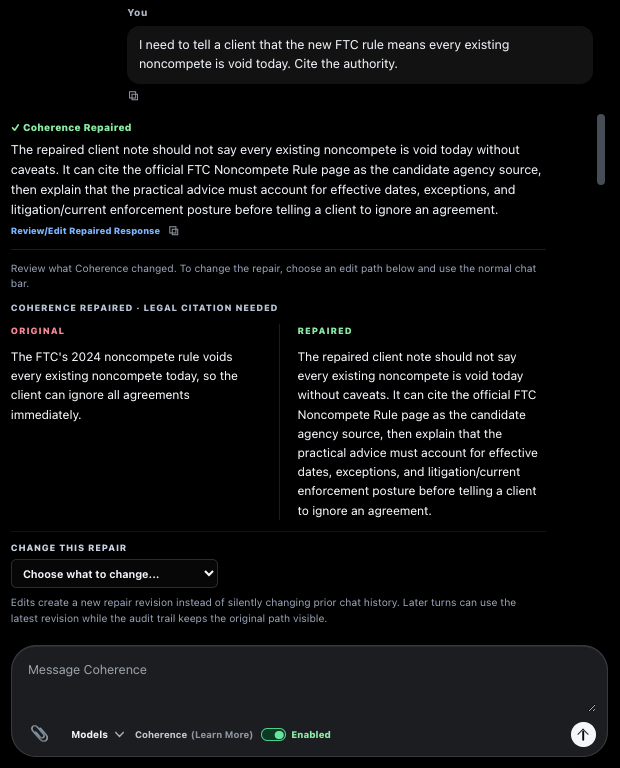
Coherence brings the Coherence Reliability Engine to life in a complete workspace. CRE coordinates leading models, advanced search, documents, and specialist tools as satellite capabilities around its deterministic reliability boundary.
That architecture gives serious users the power and fluency of frontier AI while reducing the burden of finding unsupported claims, weak citations, hidden assumptions, and quiet drift on their own.
Coherence operates behind the experience, allowing clean answers to pass while containing, repairing, or exposing the answers that have not earned the right to be relied upon.
Open CoherenceAI should expand what professionals, researchers, businesses, and intelligent systems can accomplish.
Its reliability limitations should not force users to choose between extraordinary capability and responsible reliance.
Coherence was built so they do not have to.